


SCPコンプレックス-LSとは?
Chum salmon migrate through the northern seas and return to the rivers of Hokkaido.
SCP Complex-LS makes effective use of nasal cartilage and employs unique manufacturing techniques.
This is a functional composite ingredient for food use that standardizes undenatured type II and type XI collagen and undenatured proteoglycan into a single raw material.
We are transforming Hokkaido's natural resources into new value that supports health.
非変性Ⅱ型・Ⅺ型コラーゲン | 非変性プロテオグリカン | PG分子量 | 原 料 |
|---|---|---|---|
40%以上 | 40%以上 | 200万~415万 Da | 北海道産シロ鮭鼻軟骨 |
SCP Complex-LS Product Specifications


Purpose of use

Joint care products
As an ingredient to be incorporated into supplement products aimed at alleviating joint discomfort.

Knee health
As an ingredient in supplement products intended to assist joint movement.
Consistent in-house manufacturing to support raw material quality
原料の調達から製造、品質管理まで、自社で一貫して行っています。
各工程を自社で管理することで、原料の特性を把握しながら、安定した品質の維持に取り組んでいます。

What is HealthyDo ?


It started in Hokkaido.
This company was a pioneer in labeling food products for their functional properties.
It was established in Hokkaido in 2013, ahead of the national functional food labeling system.
This is a system in which Hokkaido certifies foods containing functional ingredients that have undergone scientific research.
2013
HealthyDo is born.

2015
Functional labeling food system started


A system originating in Hokkaido
Born in the region
This is a pioneering initiative.
Based on scientific research
This focuses on functional materials based on research data.
Foods containing functional ingredients are certified.
Hokkaido Prefecture certifies foods containing functional ingredients that have been subjected to scientific research.


HealthyDo certified product
SCP Supplements
Product Features: Salmon nasal cartilage extract
Certification number: No. 08-0073
Functional ingredients: Undenatured type II collagen and proteoglycan derived from salmon nasal cartilage
Content of functional ingredients in certified products: 1 tablet (170mg)

Four reasons why SCP Complex - LS was chosen
01
The only composite standard raw material
Undenatured type II and type XI collagen and proteoglycans are contained within the same raw material, standardized to contain 40% or more of each.
02
Unique manufacturing process that prioritizes non-denaturation
The manufacturing process, which takes into account the characteristics of the raw materials, maintains the non-denaturation of the main components.
03
Quality control and safety
From raw material acceptance to finished product, manufacturing takes place under the quality control system of certified factories.
04
Effective use of resources from Hokkaido
北海道産シロサケ鼻軟骨を活用し、未利用資源に新たな価値を創出。
Proof of nonvariance
① Confirmation of the composition of type II and type XI collagen

The α1(II) chain and type XI collagen-related bands of type II collagen were identified.
This analysis supports the finding that SCP Complex-LS contains type II and type XI collagen.
*SDS-PAGE is an analysis that shows the molecular weight pattern and does not evaluate non-denaturation itself.
② Proof of nonvariance
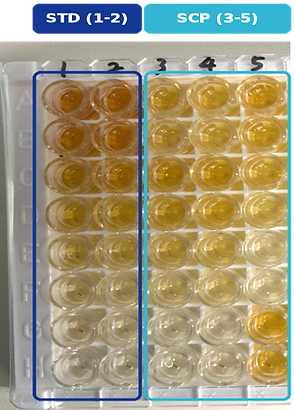
Top row: Measurement plate
Bottom panel: Schematic diagram of the measurement principle
1-2 rows: STD (standard solution)
Rows 3-5: SCP Products (Dilution Series)
Chondrex Type II Collagen Detection ELISA
Confirmation of undenatured type II collagen: Salmon type II collagen, which retains its triple helix structure, is recognized in a sandwich-like manner. Quantification is performed using a calibration curve of standard solutions.

非変性サケⅡ型コラーゲン(三重らせん)と抗体の反応[模式図]
How to read an ELISA plate
STD
Standard solution of known concentration
SCP
3-5 rows, dilution series
Pale color
Low absorbance
Intense color
High absorbance
The composition of type II and type XI collagen, and the antibody reaction to undenatured type II collagen,
Each was confirmed using a different analytical method.
Confirmation of thermal transition by differential scanning calorimetry.

DSC is a method for evaluating endothermic changes and denaturation temperatures associated with the thermal denaturation of collagen by measuring the heat difference between a sample and a reference substance. A clear change in heat flow was observed in the DSC curve at around 48-50°C, indicating the presence of a heating-responsive molecular structure within the sample.
Measurement conditions Sample: SCP Heating: 9 → 90°C, 2°C/min
Sample quantity: 35.300 mg
Atmosphere: N₂ 50 mL/min
DSC (Differential Scanning Calorimetry) is an analytical method that captures the thermal changes of a sample during heating.
These results indicate that a thermal transition occurred in the unheated sample at approximately 48-50°C.
When publishing peak temperature and transition heat values, please verify them against the original data analysis values and test reports.
Research areas of proteoglycans at a glance
Research reports on salmon nasal cartilage-derived proteoglycans exist in the following areas:


Research on knee condition and cartilage metabolism.
01 Joints and cartilage [1-3,19]


Relationship with cytokines and allergy response.
02 Immune response [4-6]

03 Intestinal environment [7-9]

Intestinal bacterial sac, short-chain fatty acids, and colitis model.

04Skin /UV [10]
Skin changes caused by UVB and barrier-related indicators.


05 Wounds and Hair [11-14]

Research on fibroblasts, wound repair, and hair growth.


06 代謝 [15-16]
脂質関連指標と腸管での糖輸送に関する研究。
参考文献一覧
№ | Title |
|---|---|
1 | Tomonaga A, Takahashi T, Tanaka YT, et al. Evaluation of the effect of salmon nasal proteoglycan on biomarkers for cartilage metabolism in individuals with knee joint discomfort: a randomized double-blind placebo-controlled clinical study. Exp Ther Med. 2017;14:115–126. DOI |
2 | Yoshimura S, Asano K, Nakane A. Attenuation of collagen-induced arthritis in mice by salmon proteoglycan. Biomed Res Int. 2014;2014:406453. DOI |
3 | Yu M, Jo SE, Son YB, et al. Salmon nasal cartilage proteoglycan ameliorate joint pain and cartilage degradation by regulating catabolic and anabolic homeostasis in MIA-induced osteoarthritis. Nutrients. 2026;18:176. DOI |
4 | Sashinami H, Takagaki K, Nakane A. Salmon cartilage proteoglycan modulates cytokine responses to Escherichia coli in mouse macrophages. Biochem Biophys Res Commun. 2006;351:1005–1010. DOI |
5 | Mitsui T, Sashinami H, Sato F, et al. Salmon cartilage proteoglycan suppresses mouse experimental colitis through induction of Foxp3+ regulatory T cells. Biochem Biophys Res Commun. 2010;402:209–215. DOI |
6 | Ono HK, Yoshimura S, Hirose S, et al. Salmon cartilage proteoglycan attenuates allergic responses in mouse model of papain-induced respiratory inflammation. Mol Med Rep. 2018;18:4058–4064. DOI |
7 | Asano K, Yoshimura S, Nakane A. Alteration of intestinal microbiota in mice orally administered with salmon cartilage proteoglycan, a prophylactic agent. PLoS One. 2013;8:e75008. DOI |
8 | Ota S, Yoshihara S, Ishido K, et al. Effects of proteoglycan on dextran sulfate sodium-induced experimental colitis in rats. Dig Dis Sci. 2008;53:3176–3183. DOI |
9 | Kudo K, Kobayashi T, Kasai K, et al. Chondroitin sulfate is not digested at all in the mouse small intestine but may suppress interleukin 6 expression induced by tumor necrosis factor-alpha. Biochem Biophys Res Commun. 2023;642:185–191. DOI |
10 | Lee HR, Hong SM, Cho K, et al. Potential role of dietary salmon nasal cartilage proteoglycan on UVB-induced photoaged skin. Biomol Ther. 2024;32:249-260. DOI |
11 | Ito G, Kobayashi T, Takeda Y, Sokabe M. Proteoglycan from salmon nasal cartilage promotes in vitro wound healing of fibroblast monolayers via the CD44 receptor. Biochem Biophys Res Commun. 2015;456:792-798. DOI |
12 | Sano M, Shang Y, Nakane A, Saito T. Salmon nasal cartilage proteoglycan enhances growth of normal human dermal fibroblast through ERK1/2 phosphorylation. Biosci Biotechnol Biochem. 2017;81:1379-1385. DOI |
13 | Hirose S, Narita K, Asano K, Nakane A. Salmon cartilage proteoglycan promotes the healing process of Staphylococcus aureus-infected wound. Heliyon. 2018;4:e00587. DOI |
14 | Nakane A, Hirose S, Kawai N, et al. Salmon nasal cartilage proteoglycan stimulates hair growth. Biosci Biotechnol Biochem. 2024;88:107-110. DOI |
15 | Hirose S, Asano K, Harada S, et al. Effects of salmon cartilage proteoglycan on obesity in mice fed with a high-fat diet. Food Sci Nutr. 2022;10:577-583. DOI |
16 | Tsuchiya Y, Kawamata K, Tomita M, et al. Effects of salmon nasal cartilage proteoglycan on plasma glucose concentration and active glucose transport in the small intestine. J Nutr Sci Vitaminol. 2015;61:502-505. DOI |
17 | Kobayashi T, Kakizaki I, Nozaka H, Nakamura T. Chondroitin sulfate proteoglycans from salmon nasal cartilage inhibit angiogenesis. Biochem Biophys Rep. 2017;9:72-78. DOI |
18 | Hirasawa S, Yabe T. Salmon nasal cartilage proteoglycan: exogenous functionality compared to other chondroitin sulfates. Rev Agric Sci. 2025;13:20-35. DOI |
19 | Takahashi T, et al. Evaluation of the efficacy and safety of long-term intake of a dietary supplement containing salmon nasal cartilage-derived proteoglycan on subjects with subjective knee symptoms: an open study. Yakuri to Chiryo. 2018;46:1693-1706. URL |
20 | Kakizaki I, Mineta T, Sasaki M, et al. Biochemical and atomic force microscopic characterization of salmon nasal cartilage proteoglycan. Carbohydr Polym. 2014;103:538-549. DOI |