


SCPコンプレックス-LSとは?
北の海を回遊し、北海道の川へ帰るシロサケ。
SCPコンプレックス-LSは、その鼻軟骨を有効活用し、独自の製造技術によって
非変性Ⅱ型・Ⅺ型コラーゲンと非変性プロテオグリカンを一つの原料に規格化した、食品用機能性複合原料です。
わたしたちは、北海道の天然資源を健康を支える新たな価値へとつなげています。
非変性Ⅱ型・Ⅺ型コラーゲン | 非変性プロテオグリカン | PG分子量 | 原 料 |
|---|---|---|---|
40%以上 | 40%以上 | 200万~415万 Da | 北海道産シロ鮭鼻軟骨 |


使用用途

関節ケア製品
関節の違和感緩和を目的とした、サプリメント製品への配合素材として。

膝の健康
関節の動きを助けることを目的とした、サプリメント製品への配合素材として。
原料品質を支える一貫した自社製造
原料の調達から製造、品質管理まで、自社で一貫して行っています。
各工程を自社で管理することで、原料の特性を把握しながら、安定した品質の維持に取り組んでいます。

ヘルシーDoとは?


北海道から始まった、
食品機能性表示の先駆けです。
2013年、国の機能性表示食品制度に先駆けて北海道で誕生。
科学的研究が行われた機能性素材を含む食品を、北海道が認定する制度です。
2013年
ヘルシーDo 誕生

2015年
機能性表示食品制度 開始


北海道発の制度
地域から生まれた
先進的な取り組みです。
科学的研究に基づく
研究データに基づいた
機能性素材を対象としています。
機能性素材を含む食品を認定
科学的研究が行われた機能性素材を含む食品を、北海道が認定します。


ヘルシーDo認定商品
SCPサプリメント
商品特長:サケ鼻軟骨抽出物
認定番号:第08-0073号
機能性素材:サケ鼻軟骨由来非変性II型コラーゲン・プロテオグリカン
認定商品に含まれる機能性素材の含有量:1粒 (170mg)

SCPコンプレックス-LSが選ばれる4つの理由
01
The only composite standard raw material
Undenatured type II and type XI collagen and proteoglycans are contained within the same raw material, standardized to contain 40% or more of each.
02
Unique manufacturing process that prioritizes non-denaturation
The manufacturing process, which takes into account the characteristics of the raw materials, maintains the non-denaturation of the main components.
03
Quality control and safety
原料受け入れから製品化まで、認証工場の品質管理体制で製造。
04
北海道産資源の有効活用
北海道産シロサケ鼻軟骨を活用し、未利用資源に新たな価値を創出。
Proof of nonvariance
① Ⅱ型・Ⅺ型コラーゲンの組成確認

The α1(II) chain and type XI collagen-related bands of type II collagen were identified.
This analysis supports the finding that SCP Complex-LS contains type II and type XI collagen.
*SDS-PAGE is an analysis that shows the molecular weight pattern and does not evaluate non-denaturation itself.
② 非変性の証明
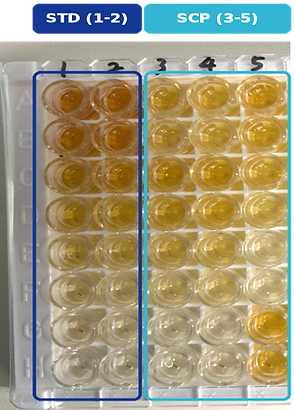
上段:実測プレート
下段:測定原理の模式図
1~2列:STD(標準液)
3~5列:SCP製品(希釈系列)
Chondrex Type II Collagen Detection ELISA
非変性Ⅱ型コラーゲンの確認三重らせん構造を保った測定対象のサケⅡ型コラーゲンをサンドイッチ状に認識。標準液の検量線から定量します。

非変性サケⅡ型コラーゲン(三重らせん)と抗体の反応[模式図]
ELISAプレートの見方
STD
既知濃度の標準液
SCP
3~5列・希釈系列
淡い発色
低い吸光度
濃い発色
高い吸光度
Ⅱ型・Ⅺ型コラーゲンの組成と、非変性Ⅱ型コラーゲンに対する抗体反応を、
それぞれ異なる分析法で確認しています。
示差走査熱量測定による熱転移の確認

DSCは、試料と基準物質との熱量差を測定し、コラーゲンの熱変性に伴う吸熱変化や変性温度を評価する方法約48~50℃付近で変性確認DSC曲線に明瞭な熱流変化を確認。加熱に応答する分子構造が試料中に存在することを示す補助データです。
測定条件試料:SCP昇温:9→90℃、2℃/min
試料量:35.300 mg
雰囲気:N₂ 50 mL/min
DSC(示差走査熱量測定)は、加熱に伴う試料の熱的変化を捉える分析です。
本結果は、非加熱試料で約48~50℃付近に熱転移が認められたことを示します。
ピーク温度・転移熱量を掲載する場合は、元データの解析値および試験報告書と照合してください。


参考文献一覧
№ | Title |
|---|---|
1 | Tomonaga A, Takahashi T, Tanaka YT, et al. Evaluation of the effect of salmon nasal proteoglycan on biomarkers for cartilage metabolism in individuals with knee joint discomfort: a randomized double-blind placebo-controlled clinical study. Exp Ther Med. 2017;14:115–126. DOI |
2 | Yoshimura S, Asano K, Nakane A. Attenuation of collagen-induced arthritis in mice by salmon proteoglycan. Biomed Res Int. 2014;2014:406453. DOI |
3 | Yu M, Jo SE, Son YB, et al. Salmon nasal cartilage proteoglycan ameliorate joint pain and cartilage degradation by regulating catabolic and anabolic homeostasis in MIA-induced osteoarthritis. Nutrients. 2026;18:176. DOI |
4 | Sashinami H, Takagaki K, Nakane A. Salmon cartilage proteoglycan modulates cytokine responses to Escherichia coli in mouse macrophages. Biochem Biophys Res Commun. 2006;351:1005–1010. DOI |
5 | Mitsui T, Sashinami H, Sato F, et al. Salmon cartilage proteoglycan suppresses mouse experimental colitis through induction of Foxp3+ regulatory T cells. Biochem Biophys Res Commun. 2010;402:209–215. DOI |
6 | Ono HK, Yoshimura S, Hirose S, et al. Salmon cartilage proteoglycan attenuates allergic responses in mouse model of papain-induced respiratory inflammation. Mol Med Rep. 2018;18:4058–4064. DOI |
7 | Asano K, Yoshimura S, Nakane A. Alteration of intestinal microbiota in mice orally administered with salmon cartilage proteoglycan, a prophylactic agent. PLoS One. 2013;8:e75008. DOI |
8 | Ota S, Yoshihara S, Ishido K, et al. Effects of proteoglycan on dextran sulfate sodium-induced experimental colitis in rats. Dig Dis Sci. 2008;53:3176–3183. DOI |
9 | Kudo K, Kobayashi T, Kasai K, et al. Chondroitin sulfate is not digested at all in the mouse small intestine but may suppress interleukin 6 expression induced by tumor necrosis factor-alpha. Biochem Biophys Res Commun. 2023;642:185–191. DOI |
10 | Lee HR, Hong SM, Cho K, et al. Potential role of dietary salmon nasal cartilage proteoglycan on UVB-induced photoaged skin. Biomol Ther. 2024;32:249-260. DOI |
11 | Ito G, Kobayashi T, Takeda Y, Sokabe M. Proteoglycan from salmon nasal cartilage promotes in vitro wound healing of fibroblast monolayers via the CD44 receptor. Biochem Biophys Res Commun. 2015;456:792-798. DOI |
12 | Sano M, Shang Y, Nakane A, Saito T. Salmon nasal cartilage proteoglycan enhances growth of normal human dermal fibroblast through ERK1/2 phosphorylation. Biosci Biotechnol Biochem. 2017;81:1379-1385. DOI |
13 | Hirose S, Narita K, Asano K, Nakane A. Salmon cartilage proteoglycan promotes the healing process of Staphylococcus aureus-infected wound. Heliyon. 2018;4:e00587. DOI |
14 | Nakane A, Hirose S, Kawai N, et al. Salmon nasal cartilage proteoglycan stimulates hair growth. Biosci Biotechnol Biochem. 2024;88:107-110. DOI |
15 | Hirose S, Asano K, Harada S, et al. Effects of salmon cartilage proteoglycan on obesity in mice fed with a high-fat diet. Food Sci Nutr. 2022;10:577-583. DOI |
16 | Tsuchiya Y, Kawamata K, Tomita M, et al. Effects of salmon nasal cartilage proteoglycan on plasma glucose concentration and active glucose transport in the small intestine. J Nutr Sci Vitaminol. 2015;61:502-505. DOI |
17 | Kobayashi T, Kakizaki I, Nozaka H, Nakamura T. Chondroitin sulfate proteoglycans from salmon nasal cartilage inhibit angiogenesis. Biochem Biophys Rep. 2017;9:72-78. DOI |
18 | Hirasawa S, Yabe T. Salmon nasal cartilage proteoglycan: exogenous functionality compared to other chondroitin sulfates. Rev Agric Sci. 2025;13:20-35. DOI |
19 | Takahashi T, et al. Evaluation of the efficacy and safety of long-term intake of a dietary supplement containing salmon nasal cartilage-derived proteoglycan on subjects with subjective knee symptoms: an open study. Yakuri to Chiryo. 2018;46:1693-1706. URL |
20 | Kakizaki I, Mineta T, Sasaki M, et al. Biochemical and atomic force microscopic characterization of salmon nasal cartilage proteoglycan. Carbohydr Polym. 2014;103:538-549. DOI |